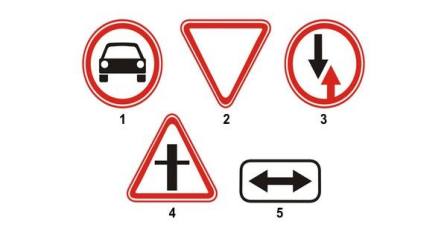
Which of the following signs obliges to give way to vehicles entering or approaching a narrow section of the road in the opposite direction?
Answer options
Explanation
Sign 3 — the "priority to oncoming traffic" sign.
Sign 3 is a circle with a red border bearing two arrows: a large black arrow pointing down (the oncoming flow) and a small red arrow pointing up (you). It means that on the narrow section of road, priority belongs to vehicles coming from the opposite direction; you must stop before entering the narrow stretch and let them pass. This sign is usually posted before single-lane bridges, roadworks or sections where the carriageway is not wide enough for two vehicles to pass at once.
The safety logic is that in a narrow stretch a joint decision by two drivers reaches deadlock: both enter, they meet in the middle, and one must reverse out — on a bridge or beside a parapet. The sign removes that ambiguity in advance and settles the duty one-sidedly; the red colour of your arrow means "you are the one prohibited", not merely a warning.
Worth memorising, and the classic exam trap: this symbol has two versions. The round one with a red border means you give way; the blue square one with a large white arrow means you have priority. Take the background colour as your test: red and round = duty, blue and square = privilege. Every time you see this pair, look first at shape and colour, then at the direction of the arrows.
• Sign 1 is "no entry for motor vehicles"; it says nothing about priority but prohibits entry. It is chosen only because it too is round and red. • Sign 2 is the inverted "give way" triangle and relates to a crossing road, not to a narrow stretch and oncoming traffic. The similarity in "giving way" is deceptive, but its place of application is a junction. • Sign 4 is the warning triangle for a junction; it merely announces that a junction lies ahead and creates no duty to give way on its own. • Sign 5 is a supplementary plate with a double-headed arrow. A plate never has meaning on its own; it only defines the extent or direction of application of the main sign above it.
Topic
The official Armenian theory exam has 20 questions. You may make at most 2 mistakes. Start mock exam
Related questions
- Which of the following signs obliges you to give way to oncoming vehicles?
- What sign requires you to give way to vehicles traveling on an intersecting road?
- What sign requires you to give way to vehicles traveling on an intersecting road?
- What sign requires you to give way to vehicles traveling on an intersecting road?
- If it is difficult to pass on the slopes marked with the appropriate sign, you must give way
- If the values of traffic lights signals contradict the requirements of traffic priority signs, drivers should be guided by.
- With which of the signs must you give way to oncoming traffic on a narrow section?
- At an unregulated intersection, which signs give the driver priority over those travelling on the crossing road?