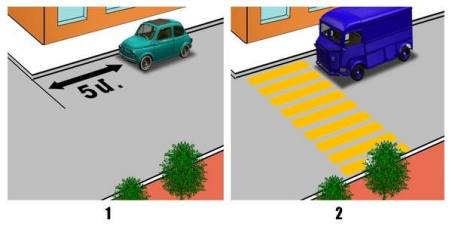
In which picture did the driver correctly stop his car to drop off passengers?
Answer options
Explanation
In the left picture.
Stopping on a pedestrian crossing and closer than 5 metres to it is prohibited, and setting down a passenger creates no exception to that prohibition.
In picture 1 the car is standing beside the kerb and outside the prohibited zone; the "5 m" arrow shows exactly the minimum distance the law requires. In picture 2 the blue van has stopped right on the yellow pedestrian markings and has blocked the pedestrians' path — which means a pedestrian is forced to pass beside the car and out into the carriageway.
The safety reason for this rule is "visibility". A car stopped near a crossing acts like a curtain: a pedestrian emerging from behind it is not seen until the last moment, and the driver in the adjacent lane has no time to brake. Those few metres of distance are exactly what gives both parties time to react; most pedestrian accidents on crossings begin with just such a blocked view.
The common exam trap is to take the duration of the stop as the criterion and think "a few seconds to set a passenger down does no harm". The law's criterion is the place of stopping, not its duration; the moment your wheels are on the crossing, the offence has been committed.
• Tempting, because both cars are standing neatly beside the kerb, but picture 2 is a stop on a pedestrian crossing and is not acceptable in any way. • In the right-hand picture the van has stopped exactly on the pedestrian crossing; that is the clearest form of a prohibited stop, not a correct one.
Topic
The official Armenian theory exam has 20 questions. You may make at most 2 mistakes. Start mock exam
Related questions
- Is it allowed to put off a passenger on the road where a solid yellow line is drawn on the top surface of the curb and a "Stop is prohibited" sign is placed?
- Is it allowed to stop to put off a passenger in this case?
- If the traffic through a railway crossing is prohibited and there are no traffic lights, road signs, markings and a barrier, the driver must stop:
- At what distance from the railway crossing is the parking of vehicles prohibited?
- If traffic through the railway crossing is prohibited and there are no traffic lights, road signs and markings, the driver must stop:
- Is the vehicle allowed to stop at the specified place to drop off the passenger?
- The driver of the bus has made a stop to board passengers. A passenger car is moving at a speed of 70 km/h. Which vehicle driver violated the traffic rules?
- Is the driver of public transport performing regular passenger transportation allowed to stop at the given place for the purpose of boarding passengers?