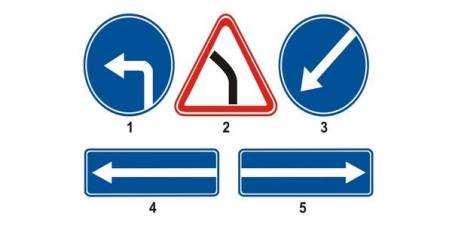
What sign is called "An obstacle bypass on the left"?
Answer options
Explanation
Sign number 3 — the blue disc with a white diagonal arrow pointing down and to the left.
Round signs with a blue background are mandatory signs: they impose the direction drawn on them. On sign 3 the diagonal arrow pointing down-and-left says the obstacle ahead must be passed on its left side; that is, the obstacle stays on your right. This sign is mounted on the obstacle itself or immediately before it: a central island, a bridge pier, a repair zone, or a blocked-off part of the carriageway.
The safety logic is simple and important. When an obstacle breaks the traffic flow and drivers are not told what to do, some pass on the right and some on the left, and that spontaneous fork means a side impact; and if someone swerves left and crosses into the oncoming lane, it means a head-on collision. This sign takes the decision away from the driver and defines a single path. That is also why it is made with a reflective surface, so that the edge of the obstacle is visible from a distance at night and in rain.
Worth memorising: the tip of the arrow points to the side you must pass on, and the downward slope of the arrow means "right here, immediately", not at the next intersection. The common exam trap is confusing a mandatory turn sign with a pass-the-obstacle sign; the former concerns an intersection, the latter an obstacle. The mirror twin of this sign is the diagonal arrow pointing down-and-right, meaning pass the obstacle on the right.
• Sign 1 is also blue and round and its arrow goes left, so it is tempting; but its curved arrow means "turn left" and refers to the intersection ahead, not to passing an obstacle. • Sign 2 is a red triangle, so it belongs to the warning group; it only warns of a dangerous bend ahead and gives no instruction about which side to pass. • Sign 4 is a blue rectangle with a horizontal arrow; it is an information sign about a one-way road and the direction of travel on it. The rectangular shape means "I inform", not "I command". • Sign 5 is the same as sign 4 in the opposite direction; again it is one-way road information and has nothing to do with an obstacle.
Road Traffic Regulations of the Republic of Armenia
Topic
The official Armenian theory exam has 20 questions. You may make at most 2 mistakes. Start mock exam
Related questions
- If it is difficult to pass on the slopes marked with the appropriate sign, you must give way
- Is it allowed to turn into the yard at this point?
- Which answer correctly states the permitted direction of travel?
- Which answer correctly states the permitted direction of traffic?
- In which picture does the driver correctly perform the maneuver?
- On roads with two-way traffic, in the absence of road signs, markings and dividing strips, drivers must bypass the elements of road structures on the roadway:
- Is the driver of the red car allowed to continue driving in this situation?
- The drivers of which vehicles violated the requirements of the road sign?