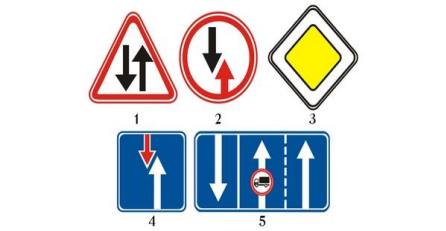
Which sign gives the driver an advantage over oncoming vehicles?
Answer options
Explanation
Sign number 4, that is "priority over oncoming vehicles".
Sign number 4 is a blue rectangle with one large white arrow pointing up and one small red arrow pointing down. The blue colour means good news for you: on the narrow section ahead you go first and the oncoming vehicle must wait. Sign number 2 is the mirror image of this one; round with a red border and a large red arrow, meaning you must give way.
The point to memorise is that in both signs the large arrow belongs to whoever has priority, and the red arrow always represents the oncoming traffic. If the red arrow is small, you are in the right; if the red arrow is large, you must stop. The shape helps too: a circle with a red border is a duty and a prohibition, a blue rectangle is information and a privilege.
This pair of signs is posted at narrow bridges, defiles and sections where the road width is not enough for two vehicles to pass at once. If the legislator did not assign priority for such a place, two drivers would enter from either end of the narrow stretch and either lock together in the middle or reverse out; both outcomes are dangerous on a mountain road. Assigning priority one-sidedly takes the decision out of a moment-by-moment negotiation between two drivers.
• Sign 1 is merely a "two-way traffic" warning and gives priority to nobody; it simply announces that oncoming traffic exists. • Sign 2 is exactly the reverse of the correct answer: with it you are obliged to give way to the oncoming vehicle. • The yellow diamond means priority road and gives priority only over minor roads at junctions, not over the traffic coming towards you. • Sign 5 shows the direction of travel in the lanes and allocates one lane to route vehicles; its subject is lane allocation, not priority against oncoming traffic.
Topic
The official Armenian theory exam has 20 questions. You may make at most 2 mistakes. Start mock exam
Related questions
- Which of the following signs obliges you to give way to oncoming vehicles?
- Is the bus driver allowed to overtake in the zone of this sign?
- Which sign prohibits a U-turn?
- Does the driver have the right to make a U-turn at a distance of 200 meters from the sign in this situation?
- A U-turn after the sign is
- With which of the signs must you give way to oncoming traffic on a narrow section?
- Which of the signs prohibits a U-turn?
- Which of the signs warns of approaching the beginning of a road section with oncoming traffic?