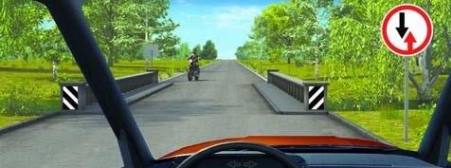
Is it allowed to cross the bridge if it does not obstruct the driver of the motorcycle?
Answer options
Explanation
Yes — as long as your passage creates no obstruction for the motorcyclist, crossing the bridge is allowed.
The round sign on the right of the picture, with a red border, a large black downward arrow and a red upward arrow, means "give way to oncoming traffic". This sign does not prohibit passage; it merely settles the duty: on the narrow crossing ahead, priority belongs to the vehicle coming from the opposite side and you must wait. But the prohibition is conditional, not absolute. If your entry onto the bridge does not force the oncoming driver to slow, stop or change course, moving off is allowed.
The safety reason is visible in the picture itself: the bridge is bounded by two striped barrier posts on each side and its usable width is small. If both drivers enter at once, one will have to reverse on the bridge; reversing on a narrow structure with a drop at the edge is the most dangerous manoeuvre imaginable. That is precisely why the legislator settles the duty before entry, so that nobody faces the problem of backing off in mid-bridge.
The common exam trap is to equate this sign with "no entry" and pick "No" unconditionally. Memorise its counterpart too: the rectangular blue sign with a large white arrow and a small red one means the opposite — priority is yours.
• "No" would be right if the sign closed entry absolutely; but this sign only assigns priority and sets a condition. Given the premise of the question — no obstruction — no reason to stop remains.
Topic
The official Armenian theory exam has 20 questions. You may make at most 2 mistakes. Start mock exam
Related questions
- If it is difficult to pass on the slopes marked with the appropriate sign, you must give way
- What sign is called "An obstacle bypass on the left"?
- Is it allowed to turn into the yard at this point?
- Which answer correctly states the permitted direction of travel?
- Which answer correctly states the permitted direction of traffic?
- In which picture does the driver correctly perform the maneuver?
- On roads with two-way traffic, in the absence of road signs, markings and dividing strips, drivers must bypass the elements of road structures on the roadway:
- Is the driver of the red car allowed to continue driving in this situation?