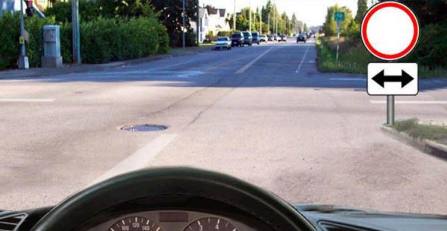
In which direction the driver is allowed to drive:
Answer options
Explanation
Straight ahead, and also a U-turn.
The round white sign with a red border is "no entry", but the plate beneath it limits its scope: the horizontal double-headed arrow means this prohibition relates to the roads going right and left at the junction ahead. So entering the crossing road — whether from the right or the left — is closed and the straight route remains open. A U-turn is not prohibited either, because in a U-turn you do not enter the crossing road and stay on the road you are already on.
The general rule this question teaches is: a plate never creates a duty on its own; it merely says where and on what the sign above it takes effect. If you ignore the plate, you read the sign as many times stricter than it is and imagine the road is closed altogether.
The use of this combination in a city is clear: with it, the lanes or side streets of a junction can be closed to through traffic — a residential area, a market or a narrow street — without cutting the main flow of the road. The common exam trap is that the candidate automatically places a U-turn on the list of prohibitions, whereas neither the sign nor the plate has said anything about U-turns.
• This is exactly the reverse of the truth: right and left are the two directions the double-headed arrow plate assigns to the prohibition. • "Straight ahead only" is half right, and tempting for that reason; but it excludes a U-turn without cause, because a U-turn is not entry onto the crossing road.
Topic
The official Armenian theory exam has 20 questions. You may make at most 2 mistakes. Start mock exam
Related questions
- Is it allowed to enter the area marked with this sign when making a right turn?
- Is it allowed to stop in the passenger boarding lane marked with this sign?
- What sign is called "Intersection with a bicycle lane" ?
- What trajectory is allowed to bypass an obstacle in this situation?
- What should a driver do if he / she intends to make a right turn at an intersection?
- In which direction is a passenger car allowed to drive?
- A U-turn from the specified lane is
- Which of these signs applies only to the lane above which it is mounted?