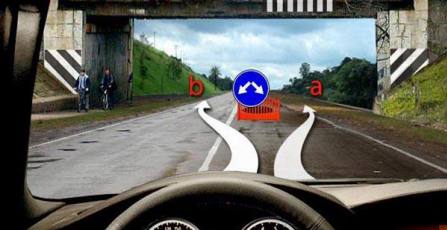
What trajectory is allowed to bypass an obstacle in this situation?
Answer options
Explanation
Both trajectories "a" and "b"; the obstacle may be passed on the right or on the left.
On the obstacle in the middle of the road — that red divider beneath the bridge — a round blue sign is mounted bearing two arrows, one deviating to the left and one to the right. That is exactly what this sign means: pass on the right or the left of the obstacle. So trajectory "a", which goes round the right, and trajectory "b", which goes round the left, are both permitted and the choice is yours.
This sign has two sisters whose arrow is single-headed and which leave only one side open; tell them apart by the number of arrows, not by habit. That is exactly where the common exam trap lies: many, recalling the general rule of keeping right, immediately choose "right only", whereas the two-arrow sign expressly sets that rule aside at this point.
The reason such a sign exists is practical: when a bridge pier or a central island divides the carriageway into two passable openings, closing one of them would only create queues and needless stopping. Even so, permitted does not mean safe; before choosing a side, judge the width of the opening, the oncoming vehicles and any pedestrians. In this very picture two people with bicycles are standing on the left beneath the bridge, so if you choose trajectory "b" you must reduce speed and leave adequate lateral clearance.
• Trajectory "a" really is permitted, and that is what makes this option deceptive; its fault is exclusivity. With two arrows the sign has left the left side open too, and there is no reason to eliminate "b". • Trajectory "b" is permitted as well, but if the sign wanted passage on the left only, its arrow would be single-headed and pointing left; here both sides are marked.
Topic
The official Armenian theory exam has 20 questions. You may make at most 2 mistakes. Start mock exam
Related questions
- Is it allowed to enter the area marked with this sign when making a right turn?
- Is it allowed to stop in the passenger boarding lane marked with this sign?
- What sign is called "Intersection with a bicycle lane" ?
- In which direction the driver is allowed to drive:
- What should a driver do if he / she intends to make a right turn at an intersection?
- In which direction is a passenger car allowed to drive?
- A U-turn from the specified lane is
- Which of these signs applies only to the lane above which it is mounted?