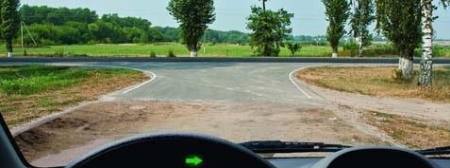
When leaving the sandy road for the asphalt-concrete road
Answer options
Explanation
You must treat the asphalt road as the priority road and give way to it.
In the picture you are behind the wheel on an unpaved road that meets a surfaced road, and no priority sign is posted at the junction. The rule is clear: whenever a dirt or gravel road meets a surfaced road, the surfaced road counts as the priority road in its own right, even if there is no sign. So you are obliged to slow down, stop before entering the carriageway if necessary, and let the vehicles travelling on the surfaced road pass first.
The safety logic of this rule has two layers. First, traffic on a surfaced road moves at higher speed and expects a smooth flow; if any field track could cut across that flow, high-energy angled collisions would be inevitable. Second, pulling out of a dirt surface is always slow and low-grip: the wheels spin, gravel spreads onto the asphalt and acceleration takes time; the driver of such a vehicle cannot confidently fill a small gap in traffic.
Worth memorising: the absence of a sign does not mean the roads are equal. Equality applies only when both roads have the same surface — both paved or both unpaved — in which case the "right-hand" rule applies. Likewise, emerging from a yard, a car park or an adjacent territory is always subordinate.
• Treating the two roads as equal is tempting because no sign is visible at the junction; but the type of surface is itself decisive, and a dirt road is never equal to a surfaced road.
Topic
The official Armenian theory exam has 20 questions. You may make at most 2 mistakes. Start mock exam
Related questions
- Does the learner have to wear seat belts while driving?
- Is it allowed to travel in the width indicated by the center of the traffic area?
- Are pavement or sidewalks section of the road?
- How many carriageways does this road have?
- In which picture does the road have a dividing strip?
- Start of traffic is
- If it is difficult to pass on the slopes marked with the appropriate sign, you must give way
- What sign is called "An obstacle bypass on the left"?