What does this marking mean?
Answer options
Explanation
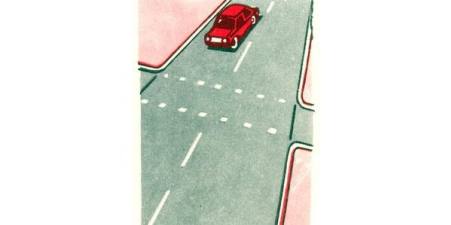
The place where a cycle path crosses the carriageway.
In the picture the carriageway is cut across by two parallel rows of small squares, and the red car is approaching that place from above. This pattern shows the place where a cycle path crosses the carriageway.
The key to identification is the shape of the bands. A pedestrian crossing is drawn with wide, continuous bands along the direction of the car's travel and from a distance looks like a striped panel; but a cycle crossing has only two dotted edges with the middle empty — exactly what you see in the picture.
Why does this difference matter? Because the safety distance you need is not the same. A cyclist reaches the carriageway faster than a pedestrian and is seen later, and a cycle path usually runs parallel to the pavement and is hidden behind trees and parked cars. On seeing this marking, reduce speed and, before reaching it, look both ways along the cycle path; in the picture, right after this place there is the entrance to an adjacent area, which shortens the view still further.
The exam trap is the option "pedestrian crossing", the most familiar meaning of any transverse marking.
• A pedestrian crossing is marked with wide, continuous bands along the direction of the car's travel, not with two rows of small squares at the two edges of an empty band. • A cattle crossing is announced by a warning sign and has no such special marking on the carriageway.
Topic
The official Armenian theory exam has 20 questions. You may make at most 2 mistakes. Start mock exam
Related questions
- This road marking allows you to drive:
- Is a driver allowed to cross a solid line marking the boundaries of parking spaces for vehicles?
- What does this marking mean?
- What does arrow markings on the roadway warn you about?
- Which of these marking lines is used to mark the boundaries of the lanes where reversing traffic occurs?
- This horizontal road marking indicates:
- With which road sign can a yellow dashed line marking be applied?
- This road marking has the following purpose: