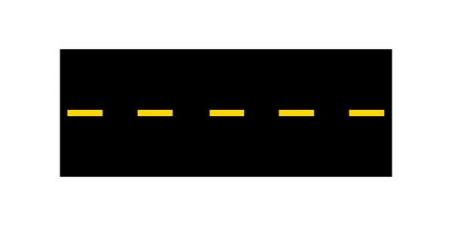
With which road sign can a yellow dashed line marking be applied?
Answer options
Explanation
Together with the "parking prohibited" sign.
There are two yellow markings beside the kerb or the edge of the carriageway, and they must be memorised as a pair. The broken yellow line shows on the ground the zone of effect of the "parking prohibited" sign, and the solid yellow line the zone of effect of the "stopping prohibited" sign. The form of the marking reflects the severity of the prohibition: broken means less strict, solid means stricter.
This mnemonic simplifies a driver's daily work. If you have not seen the sign, or it was hidden behind a tree or a lorry, the colour on the kerb settles your position. A broken yellow line means you may stop briefly to pick up or set down passengers or to load, but you have no right to park. A solid yellow line means even a brief halt is not permitted.
The safety logic of this distinction is clear too. Where parking is prohibited, the problem is the long occupation of space and the reduction of the road's usable width; a short, controlled stop is still tolerable. But where stopping is prohibited, even those few seconds blind the view or block the flow — near a junction, on a bend, on a bridge or in a tunnel. The trap of the third option is that signs about parking on odd and even days have no accompanying yellow marking and are not indicated by markings on the kerb.
• The "stopping prohibited" sign is accompanied by a solid yellow line, not a broken one; the stricter prohibition has the continuous marking. • Signs about parking on particular days of the month are not accompanied by this marking; their restriction is temporal, not a zone marked out on the kerb.
Topic
The official Armenian theory exam has 20 questions. You may make at most 2 mistakes. Start mock exam
Related questions
- If the traffic through a railway crossing is prohibited and there are no traffic lights, road signs, markings and a barrier, the driver must stop:
- If traffic through the railway crossing is prohibited and there are no traffic lights, road signs and markings, the driver must stop:
- On roads with two-way traffic, in the absence of road signs, markings and dividing strips, drivers must bypass the elements of road structures on the roadway:
- Is it allowed to put off a passenger on the road where a solid yellow line is drawn on the top surface of the curb and a "Stop is prohibited" sign is placed?
- This road marking allows you to drive:
- What does this road sign mean?
- Which vehicles are allowed to park in the area of influence of the given road sign?
- Is a driver allowed to cross a solid line marking the boundaries of parking spaces for vehicles?