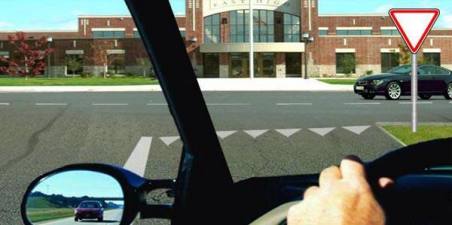
When proceeding to the left, where should a bus driver stop to give way to a passenger car?
Answer options
Explanation
At the road marking.
Two things are visible in the picture at once: the triangular "give way" sign on the right and a row of white triangles drawn on the carriageway. That marking shows precisely the place where, if necessary, you must stop in order to give way. So the bus driver must move forward to the marking and stop there, not beside the sign.
The reason is the geometry of vision. A sign is usually fitted further back and at the edge of the road; from that point you have insufficient view of the priority road, and if you stop there you both block the flow behind you for no reason and are forced to creep forward blindly in order to see the traffic. The triangular marking is drawn at the closest possible point to the crossing carriageway so that you both have a view and keep the body of your vehicle out of the passenger car's path. For a long bus that wants to turn left, those few metres are the difference between a safe turn and a side impact.
Memorise the general rule: if a stopping-place marking exists, the place to stop is that marking; if there is no marking, the edge of the crossing road's carriageway. The exam trap is the option that leaves the decision to the driver's judgement; in the priority rules the place of stopping is never a matter of judgement.
• The sign is a place of warning, not a place of stopping; standing beside the sign gives neither a sufficient view of the priority road nor agrees with the place fixed by the marking. • "A safe place at the driver's discretion" substitutes personal judgement for a rule; when a marking is drawn on the carriageway, the place of stopping has been fixed and no choice remains.
Topic
The official Armenian theory exam has 20 questions. You may make at most 2 mistakes. Start mock exam
Related questions
- Is it allowed to put off a passenger on the road where a solid yellow line is drawn on the top surface of the curb and a "Stop is prohibited" sign is placed?
- Is it allowed to stop to put off a passenger in this case?
- In which picture did the driver correctly stop his car to drop off passengers?
- If the traffic through a railway crossing is prohibited and there are no traffic lights, road signs, markings and a barrier, the driver must stop:
- At what distance from the railway crossing is the parking of vehicles prohibited?
- If traffic through the railway crossing is prohibited and there are no traffic lights, road signs and markings, the driver must stop:
- Is the vehicle allowed to stop at the specified place to drop off the passenger?
- The driver of the bus has made a stop to board passengers. A passenger car is moving at a speed of 70 km/h. Which vehicle driver violated the traffic rules?