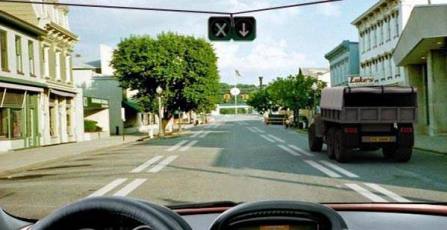
What does this road marking indicate on the roadway?
Answer options
Explanation
The boundaries of traffic lanes with reversible traffic.
The key to recognition is the shape of the marking: two parallel broken lines side by side. The boundary between lanes travelling in the same direction is drawn with a single broken line; when you see two broken lines side by side, it means the direction of travel in the adjacent lane may change at different times of day. The picture supplies a second piece of evidence too: above the carriageway are special lane signals, one with a red cross (lane closed) and one with a green downward arrow (lane open).
The safety reason for this marking is serious. In a reversible lane, a vehicle that was travelling in your direction a few minutes ago may now come towards you; that is, the risk of a head-on collision is right beside you. The double marking announces to the driver "you cannot rely on habit here" and forces him to read the signal overhead before changing lanes. If the signal is off or you cannot see it, you must behave as though the lane were prohibited and stay in your own right-hand lane.
Worth memorising: one broken line means lanes in the same direction, two broken lines mean reversible traffic. That simple distinction answers several exam questions.
• This definition belongs to a single broken line; the two parallel broken lines and the overhead cross-and-arrow signals in the picture are precisely what distinguishes reversible traffic from an ordinary street.
Topic
The official Armenian theory exam has 20 questions. You may make at most 2 mistakes. Start mock exam
Related questions
- This identification marking is used to identify vehicles:
- Which of the following road markings indicates the part of the intersection where entry is prohibited if there is a traffic jam in the direction of the traffic, which will force the driver to stop?
- Moving to the left most lane on two-way roads with three lanes marked with markings, of which the middle lane is used for traffic in both directions (except for roads with reversing traffic control)
- On roads with two-way traffic, in the absence of road signs, markings and dividing strips, drivers must bypass the elements of road structures on the roadway:
- This road marking allows you to drive:
- Is a driver allowed to cross a solid line marking the boundaries of parking spaces for vehicles?
- What does this marking mean?
- What does arrow markings on the roadway warn you about?