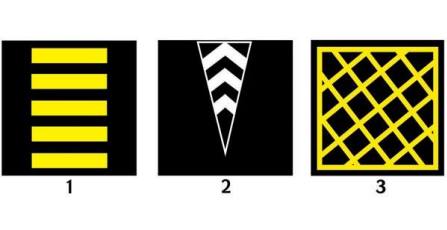
Which of the following road markings indicates the part of the intersection where entry is prohibited if there is a traffic jam in the direction of the traffic, which will force the driver to stop?
Answer options
Explanation
Marking number 3; the yellow lattice grid.
Marking number 3 is the yellow lattice grid painted on the surface of a junction, and its meaning is one thing only: do not enter this area until you are sure you can clear it completely. If a queue has formed ahead in your direction and your entry would leave you standing in the middle of the junction, entry is prohibited — even on a green light.
The safety and functional reason for this marking is junction gridlock. A vehicle stuck in the middle of a junction blocks the path of the perpendicular flow; that flow then gets stuck at the next junction, and within a few minutes a whole street network locks up. More important than the traffic, the route for ambulances and fire engines is blocked, and drivers stranded behind a stuck vehicle resort to nervous, high-risk manoeuvres. The yellow grid makes this area visually a "no-stopping zone" so that no excuse for blind entry remains.
Worth memorising: keep the yellow colour and the grid pattern together. A green light gives you permission to proceed, not permission to enter a full junction. The final decision is yours: if you have no space to exit, stay behind the line.
• Parallel yellow stripes are the marking of a pedestrian crossing; they identify where pedestrians cross and have nothing to do with entering a junction during congestion. • A chevron pattern indicates a guiding island; a place where traffic flows separate or merge, and entry by a vehicle is prohibited in general, not only during congestion.
Topic
The official Armenian theory exam has 20 questions. You may make at most 2 mistakes. Start mock exam
Related questions
- Is a driver allowed to cross a solid line marking the boundaries of parking spaces for vehicles?
- What must the driver of a vehicle do when approaching an intersection with a "stop line" and a green traffic light?
- Where should the driver stop the vehicle if this marking is present?
- Stopping is prohibited if the distance between the solid line of the marking and the stopped vehicle is:
- If the traffic through a railway crossing is prohibited and there are no traffic lights, road signs, markings and a barrier, the driver must stop:
- If traffic through the railway crossing is prohibited and there are no traffic lights, road signs and markings, the driver must stop:
- These intermittent markings at the area of the intersection indicate
- Which driver is allowed to cross the solid marking when making a stop?