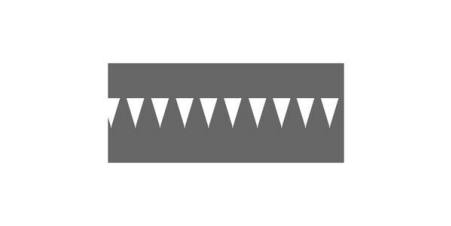
Where should the driver stop the vehicle if this marking is present?
Answer options
Explanation
Right before the marking.
The white triangles drawn across the width of the traffic lane in the picture are your stopping boundary: if you need to stop, you must stop before them — not on them and not several metres back.
The reason is the geometry of vision. This marking is drawn at a point that is both outside the path of travel of the crossing road's vehicles and offers the best angle of view onto that road. If you go beyond the line, the front of your car enters others' path and the driver on the priority road is forced to brake or manoeuvre. If you stop much further back, your view of the crossing road is blocked and you are forced to move in two stages; besides, the queue behind you grows needlessly longer.
Another point: "if necessary" means a complete stop is not always obligatory; if the crossing road is empty, reducing speed and carrying on is unobjectionable. But if you do decide to stop, this line is the place to do it.
The exam trap is the figure of 5 metres. That figure comes to mind from other rules, such as stopping restrictions relative to a pedestrian crossing or a junction, and has nothing to do with this marking. Wherever you see a numerical, precise option, make sure that number was really written for this very situation.
• Stopping on the marking itself means the front of the car has entered the conflict area; in that position your own view is restricted and you create an obstruction for the crossing road. • The figure of 5 metres has been transferred to this question from other stopping restrictions; no numerical distance is laid down for this marking, and stopping further back merely blinds your view.
Topic
The official Armenian theory exam has 20 questions. You may make at most 2 mistakes. Start mock exam
Related questions
- Is a driver allowed to cross a solid line marking the boundaries of parking spaces for vehicles?
- Stopping is prohibited if the distance between the solid line of the marking and the stopped vehicle is:
- If the traffic through a railway crossing is prohibited and there are no traffic lights, road signs, markings and a barrier, the driver must stop:
- If traffic through the railway crossing is prohibited and there are no traffic lights, road signs and markings, the driver must stop:
- Which driver is allowed to cross the solid marking when making a stop?
- Which of the following road markings indicates the part of the intersection where entry is prohibited if there is a traffic jam in the direction of the traffic, which will force the driver to stop?
- Parking is prohibited to
- Which vehicles are allowed to park?