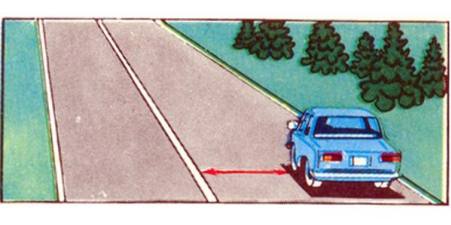
Stopping is prohibited if the distance between the solid line of the marking and the stopped vehicle is:
Answer options
Explanation
2.5 m; because it is less than the required minimum of 3 metres.
The rule has a simple figure: stopping is prohibited where the distance between the solid line of the marking (or the dividing strip, or the opposite edge of the carriageway) and the stopped vehicle is less than 3 metres. In the picture, the red arrow measures exactly that distance: from the solid line beside the carriageway to the body of the blue car standing at the roadside. So any figure below 3 metres makes stopping unlawful, and among the options only 2.5 metres is below that limit.
The safety reason for this rule concerns the width left over, not the stopped car itself. If less than 3 metres of space remains, the cars behind must cross the solid line to get past and enter the opposing path; that is, your stop effectively pushes everyone else into an offence and into a head-on collision. The same logic becomes more serious on narrow interurban roads, where visibility is limited as well.
The exam trap is thinking the criterion is the distance from the edge of the asphalt or from a pedestrian. The criterion is only the distance to the solid line (or the dividing strip or the opposite edge of the carriageway), and the key figure is 3 metres. If 3 metres or more remains, stopping is unobjectionable on that account; less than that, prohibited.
• 6 m is twice the legal limit and leaves ample space for others to pass; stopping at that distance is not prohibited. • 5.5 m is also far above 3 metres and creates no restriction. • 4 m is tempting because it has come close to the boundary figure, but it is still more than 3 metres and does not prohibit stopping. • 3.5 m is the option closest to the legal limit and is included for that reason; but it is still above 3 metres, so it remains permitted.
Topic
The official Armenian theory exam has 20 questions. You may make at most 2 mistakes. Start mock exam
Related questions
- Is a driver allowed to cross a solid line marking the boundaries of parking spaces for vehicles?
- Where should the driver stop the vehicle if this marking is present?
- If the traffic through a railway crossing is prohibited and there are no traffic lights, road signs, markings and a barrier, the driver must stop:
- If traffic through the railway crossing is prohibited and there are no traffic lights, road signs and markings, the driver must stop:
- Which driver is allowed to cross the solid marking when making a stop?
- Which of the following road markings indicates the part of the intersection where entry is prohibited if there is a traffic jam in the direction of the traffic, which will force the driver to stop?
- Parking is prohibited to
- Which vehicles are allowed to park?