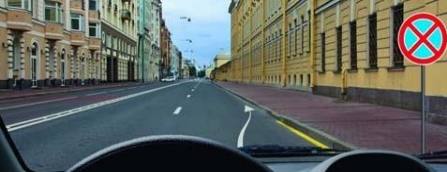
Stopping at the specified place is
Answer options
Explanation
Stopping at that point is permitted, because the sign's zone of effect ended before it.
The round blue sign with a red border and cross means "no stopping". But do not look only at the sign; look at the edge of the kerb. In the picture, a continuous yellow line runs along the right-hand kerb, and that line ends further on — the white arrow points exactly to a point beyond the end of that line, and from there on the kerb is plain and uncoloured.
The rule is: when a "no stopping" sign is used together with a yellow line along the kerb, the length of that marking defines the sign's zone of effect. Normally the zone of effect of this sign runs from where it is posted to the nearest junction (or the end of the built-up area) and relates only to the side of the road on which the sign is installed; but the yellow line shortens that zone. Since the indicated point lies outside the yellow line, stopping there is permitted.
The safety reason for this method is practical: a sign is a single point in space and can easily be missed at night, in rain or behind a lorry, whereas the yellow line runs beneath your wheels for the whole length of the prohibition and shows its boundary precisely and continuously. With that line, both stopping in a prohibited place is reduced and drivers do not needlessly drive on to the next junction.
The exam trap: seeing the red cross and answering "prohibited" at once. Always look first at how far the yellow marking runs and on which side of its end the indicated place lies.
• The red cross immediately pushes the mind towards "prohibited", but the yellow marking accompanying the sign has ended before the indicated point, and that point is no longer within the sign's zone of effect.
Topic
The official Armenian theory exam has 20 questions. You may make at most 2 mistakes. Start mock exam
Related questions
- Which of the following signs prohibits parking on even days of the month?
- Which sign indicates the zone of road signs prohibiting stopping and parking of vehicles?
- What sign (placard) indicates the method of parking a vehicle?
- Is it allowed to stop in the passenger boarding lane marked with this sign?
- Is the driver obliged to stop at the place indicated by the traffic controller in this situation?
- Which of the following road markings indicates the part of the intersection where entry is prohibited if there is a traffic jam in the direction of the traffic, which will force the driver to stop?
- Do you have to stop in front of the "Stop Line"?
- Is it allowed to make a stop at a designated place?