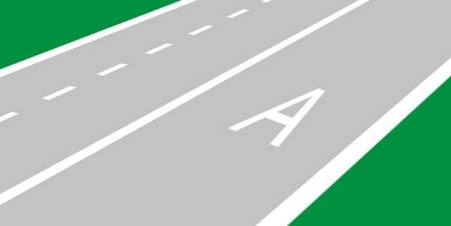
Which vehicles are allowed to drive in the right lane of the roadway?
Answer options
Explanation
Only public-transport vehicles.
The letter "A" on the carriageway marks the lane reserved for public-transport vehicles, and in this picture that lane is separated from the rest of the carriageway by a solid line. A solid line means a closed boundary: no other car has the right to enter that lane, and only public-transport vehicles travelling on a fixed route may use it.
The purpose of this separation is to preserve the speed of public transport at busy hours. A bus stuck behind a queue of passenger cars falls behind its timetable, and the very passengers who could have travelled without a car go back behind the wheel. But for the driver, the more important safety point is that this lane carries a flow with a different movement pattern: frequent stops at bus stops and slow acceleration. A passenger car entering such a lane is both committing an offence and creating a rear-end impact.
Worth memorising for the exam: do not confuse a solid line with a broken one. When this lane's boundary is solid, entry is prohibited in all cases. Where the boundary is broken, other cars may enter only to turn right or to pick up and set down passengers beside the carriageway, and then only without obstructing public-transport vehicles.
• "All motor vehicles" destroys the very function of a dedicated lane; if everyone were allowed in, there would be no need to mark it with the letter "A". • A taxi, as a hire vehicle, does not count as a public-transport vehicle running on a fixed route; adding it to the list is tempting but wrong. • A bicycle is not the subject of this marking at all; a cycle lane has its own separate marking and sign.
Topic
The official Armenian theory exam has 20 questions. You may make at most 2 mistakes. Start mock exam
Related questions
- How many traffic lanes does a road have where traffic lanes of opposite directions are separated by double solid lines?
- Which of these marking lines is used to mark the boundaries of the lanes where reversing traffic occurs?
- Is the driver of a tour bus allowed to enter the "A" lane if this marking is present?
- In populated areas, on roads with one lane of traffic in each direction, in the absence of streetcar tracks in the middle, stop and park on the left side of the road:
- Is the tourist bus driver allowed to drive in the "A" lane?
- What does the letter "A" on the lane of the roadway mean?
- In which of the following cases can a bus driver take the middle lane on a three-lane two-way road that is used for traffic in both directions?
- For which vehicles is the lane marked with the letter "A"?