What does a wide dashed line marking mean?
Answer options
Explanation
The boundary between the acceleration lane and the main carriageway.
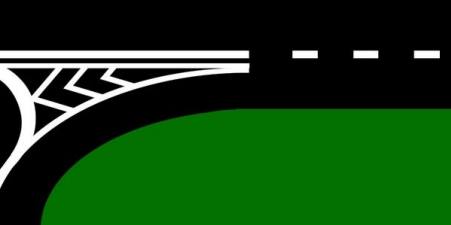
In the picture an entry road reaches the main carriageway from the left with a hatched island, and from the end of that island onwards the boundary between the added lane and the main carriageway is marked by a wide broken white line. The width of the dashes is what distinguishes this line from an ordinary lane boundary.
The message of this marking is clear: the lane you are in is an auxiliary lane, not a main one. If you are coming from the entry road, your task is to bring your speed up to that of the main flow along this lane and then enter at a suitable gap. Entering at low speed is the most dangerous thing you can do at a merge point, because a large speed difference means little reaction time for the driver arriving behind. That is why the boundary is drawn broken: crossing it is part of the merging manoeuvre itself.
From the other side there is a practical rule too: if you are travelling on the main carriageway, expect vehicles to enter at such points and give room where possible.
The exam trap is confusing this line with the boundary of the shoulder; the boundary between carriageway and shoulder is marked by a solid edge line and is neither wide nor broken.
• The boundary between the carriageway and the shoulder is marked by a solid edge line; in the picture the line is wide and broken and is drawn where an entry road joins, not at the outer edge of the road. • The geometry of the picture shows an entry road joining the main carriageway, that is, a place where the driver must gain speed; a deceleration lane is drawn at the point of leaving the carriageway, not at the point of merging.
Topic
The official Armenian theory exam has 20 questions. You may make at most 2 mistakes. Start mock exam
Related questions
- This road marking allows you to drive:
- Is a driver allowed to cross a solid line marking the boundaries of parking spaces for vehicles?
- What does this marking mean?
- What does arrow markings on the roadway warn you about?
- Which of these marking lines is used to mark the boundaries of the lanes where reversing traffic occurs?
- This horizontal road marking indicates:
- With which road sign can a yellow dashed line marking be applied?
- This road marking has the following purpose: