In which case, after stopping, the movement can not be resumed without permission?
Answer options
Explanation
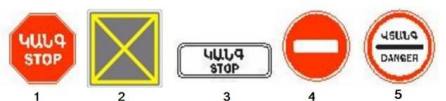
Only sign number 5, that is the "ՎՏԱՆԳ / DANGER" sign.
Sign number 5 closes the road; it does not merely require a stop. This sign is posted when continuing along the road has been prohibited for all vehicles without exception because of a crash, a fire, a landslide or another danger. So the correct response to it is: stop and wait; continuing at your own judgement is not possible and becomes permitted only when the officer at the scene allows it or the sign itself is removed.
Its difference from signs 1 and 3 — both of which are "ԿԱՆԳ / STOP" — lies exactly here: a STOP sign requires one complete halt from you, but after that halt you decide to move by looking and judging the road safe, and you need nobody's permission. Sign 4 is "no entry"; there you do not enter at all and the question of "resuming movement after a stop" does not arise.
The safety logic of this distinction is clear: the danger behind sign 5 — the crash site, the fire, the rescue crew — is hidden from the driver's view and the driver has no data with which to assess it. That is why the law takes the decision away from the driver and gives it to someone who can see the scene.
Worth memorising: "stop" means halt and then move with caution; "danger" means halt and then move only with permission.
• Sign 2 creates no requirement of "stopping until permission is given"; its cross-like shape makes it look threatening, and that appearance is what makes the option tempting. • Sign 1 is the same "stop": a complete halt is compulsory, but after halting you assess the road yourself and move; placing it beside 5 confuses two different concepts. • "All" means you have brought even "no entry" into this category, whereas there there is no stop and no permission; entry is prohibited outright.
Topic
The official Armenian theory exam has 20 questions. You may make at most 2 mistakes. Start mock exam
Related questions
- Which of the following signs prohibits parking on even days of the month?
- Which sign indicates the zone of road signs prohibiting stopping and parking of vehicles?
- What sign (placard) indicates the method of parking a vehicle?
- Is it allowed to stop in the passenger boarding lane marked with this sign?
- Is the driver obliged to stop at the place indicated by the traffic controller in this situation?
- Which of the following road markings indicates the part of the intersection where entry is prohibited if there is a traffic jam in the direction of the traffic, which will force the driver to stop?
- Do you have to stop in front of the "Stop Line"?
- Stopping at the specified place is