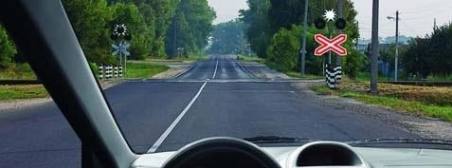
Driving through the railway crossing is
Answer options
Explanation
Permitted; the flashing white light is on and the red lights are out.
In the picture, on the right of the road, the cross-shaped level-crossing sign is visible together with the crossing's special light. The two red lights at the sides are out and the white light above is on; the barrier has not come down and the track is clear. This combination means the crossing is open and passage is permitted.
The key point is that a flashing white light is a signal of permission and not a warning of prohibition; conversely, any of the red lights flashing — even if the barrier is up and no train is in sight — means an absolute stop. Lights being completely out is not a permission either, and you must cross with full caution and after making sure there is no train.
The safety reason for the strictness at crossings is simple: a train can neither deviate nor stop within a short distance; its stopping distance runs to hundreds of metres. So the whole burden of prevention falls on the driver of the car.
Even when passage is permitted, observe these rules: before entering, look both ways along the track; do not stop on the crossing and do not enter unless you have free space beyond it; do not change gear or overtake on the crossing. The exam trap is seeing the cross-shaped sign and imagining a prohibition; that sign is a warning, not a prohibition.
• Prohibition applies when a red light is flashing, the barrier is down, or an attendant gives a stop signal; none of these applies in the picture.
Topic
The official Armenian theory exam has 20 questions. You may make at most 2 mistakes. Start mock exam
Related questions
- Are vehicles performing regular transportation of passengers on all roads allowed to occupy the left most lane of a road that has 3 or more lanes in one direction?
- The driver of the white passenger car in this situation
- Are you obligated to give way to a passenger car if you continue driving straight ahead?
- Are you obligated to give way to a passenger car if you intend to make a right turn at an intersection?
- From this lane, in which direction may the driver of the passenger car continue?
- Should the driver of a passenger car change his/her lane after overtaking the right lane?
- Is the passenger driver allowed to start movement?
- Is the passenger car driver allowed to approach the passenger on the bridge while reversing?