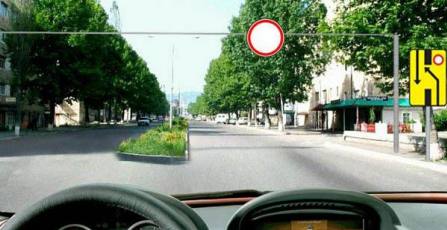
What should the driver do in this situation?
Answer options
Explanation
He should move over to the opposing carriageway.
Two signs settle the duty together. The round white sign with a red border suspended above the carriageway is "no entry" and takes effect on the very carriageway beneath which it hangs; that is, the route ahead of you is closed. The yellow sign on the right shows an arrow transferring from the current route to the adjacent carriageway: the road has been diverted onto the opposing carriageway. So the only correct action is, before reaching the closed section, to move onto the opposing carriageway with your indicator on and at the designated place.
Take the yellow background seriously: temporary signs with a yellow field take precedence over permanent signs and road markings, and their meaning is that the state of the road has changed from normal. That is also why such a sign is posted well in advance; the driver must have time to change lanes calmly and at low speed, rather than swerving a few metres before the obstacle.
Worth memorising: a white circle with a red border and no symbol at all is the strictest case and covers all vehicles. And remember that after the transfer, that carriageway has become two-way; keep well to the right, avoid overtaking and expect an oncoming vehicle.
• Continuing straight means entering a carriageway that the "no entry" sign has closed; at the end of that route there is an obstacle or a works site, not an open road.
Topic
The official Armenian theory exam has 20 questions. You may make at most 2 mistakes. Start mock exam
Related questions
- Is it allowed to enter the area marked with this sign when making a right turn?
- Which of the following signs prohibits traffic with a smaller space than the one shown on the sign?
- This road sign:
- This road sign shows:
- At what distance from the location of the dangerous part of the road are these signs placed in the settlements?
- Which of the following signs obliges to give way to vehicles entering or approaching a narrow section of the road in the opposite direction?
- Which of the following signs warns of approaching an intersection of equal roads?
- These signs allow traffic: