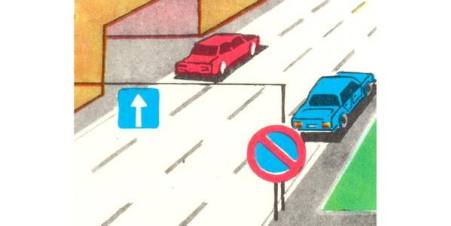
The driver of which vehicle violated the parking rules?
Answer options
Explanation
Both drivers.
Two separate offences are gathered in one picture. The round blue sign with a red border and one oblique stroke is "parking prohibited" and covers the side of the road on which it is fitted; the blue car is parked right beside that sign, within its zone of effect. The square blue sign with an upward arrow also announces that the road is one-way.
That one-way sign is the main trap of the question: drivers have learned that on a one-way road inside a built-up area parking on the left is also permitted, and they immediately acquit the red car. But that permission is only for standing beside the carriageway, not for climbing onto the pavement; and the red car is standing entirely on the pavement, hard against the building.
The safety reason is clear: the pavement is a pedestrian's only safe space. When a car occupies it, the pedestrian — and worse, a pram, a wheelchair, a child — is forced out onto the carriageway, and precisely from behind a parked car that hides him from drivers' view.
The rule to memorise: a "parking prohibited" sign closes only its own side, but the prohibition on parking on a pavement needs no sign and applies everywhere.
• It is true that the blue car is standing within the zone of the "parking prohibited" sign, but choosing only it means ignoring the red car, which has driven onto the pavement. • The red car really has committed an offence, but the blue car is parked directly beneath the "parking prohibited" sign and cannot be treated as blameless. • The one-way sign creates the impression that parking is free on both sides; but neither the "parking prohibited" sign nor the ban on standing on the pavement can be ignored.
Topic
The official Armenian theory exam has 20 questions. You may make at most 2 mistakes. Start mock exam
Related questions
- Parking is prohibited to
- Which vehicles are allowed to park?
- Is it allowed to put off a passenger on the road where a solid yellow line is drawn on the top surface of the curb and a "Stop is prohibited" sign is placed?
- Is it allowed to park the car in the mentioned place?
- Is it allowed to stop to put off a passenger in this case?
- Which driver must stop?
- Which vehicles are allowed to park in the area of influence of the given road sign?
- Is a driver allowed to cross a solid line marking the boundaries of parking spaces for vehicles?