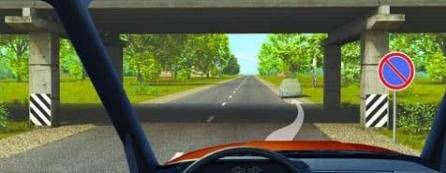
Parking after the overpass bridge is
Answer options
Explanation
It is prohibited.
Immediately after passing beneath the overpass, on the right, a round blue sign with a red border and one diagonal line is posted: "no parking". The effect of this sign begins where it is installed and continues to the first junction, to a sign ending the zone, or to the end of the built-up area. So take the answer from that sign, not from habit.
Independently of the sign there is also a general rule worth memorising: stopping on a bridge, an overpass or an underpass, and likewise beneath them, is prohibited. The safety reason for both provisions is the same: the concrete piers of the bridge completely block the view of a driver emerging from beneath the structure, and the usable width of the road is at its smallest at that very point. A vehicle parked there is seen suddenly and from a very short distance, and a driver who has come out from under the bridge at road speed has no opportunity for a safe manoeuvre.
In the picture you can also see the black-and-white striped posts on the piers; that marking means "dangerous obstacle beside the carriageway". The exam trap is that, because the sign is small and stands beside the large bridge structure, the driver does not notice it and, simply because there is no prohibitory marking on the asphalt, assumes the place is free.
• The open space and wide shoulder after the bridge make the place look like a suitable spot to stop; but the sign on the right has expressly prohibited parking, and the restricted view at the underpass exit is exactly the danger this prohibition closes off.
Topic
The official Armenian theory exam has 20 questions. You may make at most 2 mistakes. Start mock exam
Related questions
- Which of the following signs prohibits parking on even days of the month?
- Which sign indicates the zone of road signs prohibiting stopping and parking of vehicles?
- What sign (placard) indicates the method of parking a vehicle?
- Is it allowed to stop in the passenger boarding lane marked with this sign?
- Is the driver obliged to stop at the place indicated by the traffic controller in this situation?
- Which of the following road markings indicates the part of the intersection where entry is prohibited if there is a traffic jam in the direction of the traffic, which will force the driver to stop?
- Do you have to stop in front of the "Stop Line"?
- Stopping at the specified place is