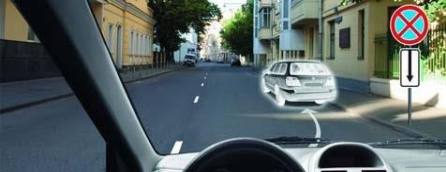
Is parking allowed in the area?
Answer options
Explanation
Yes; from this point the restriction has been lifted and parking is permitted.
The crossed sign on the post is indeed "no stopping", but the plate beneath it changes the meaning of the whole scene: an arrow with a head only at the bottom means "end of the sign's zone of effect". The restriction behind you has ended, and the road ahead of you is free of that sign's constraint; so both a brief stop and parking are unobjectionable in the area asked about.
This one plate generates three different questions, and you must recognise its three forms without hesitation: an upward arrow means the zone begins here, a double-headed arrow means you are inside the zone, and a downward arrow means the zone closes here. That is exactly the exam trap; on seeing the crossed circle the candidate instinctively chooses "no" and never looks at the plate.
The legislator's logic in marking the end of a zone is instructive too: a stopping prohibition is a costly instrument and is applied only to the stretch that genuinely has a problem — in front of an entrance, on a bend, at a constriction in the road's width, or at a stop. Rather than leaving the prohibition running to the next junction, this plate announces exactly where its work is done, so that drivers do not go looking for parking further away for no reason and the roadside is not left unused.
• A "residents only" exception is announced by a separate plate, which is not present in the picture; no such meaning follows from a downward arrow. • If the plate had an upward arrow or a double-headed arrow, "no" would be the right answer; but a downward arrow announces the end of the prohibition.
Topic
The official Armenian theory exam has 20 questions. You may make at most 2 mistakes. Start mock exam
Related questions
- Which of the following signs prohibits parking on even days of the month?
- Which sign indicates the zone of road signs prohibiting stopping and parking of vehicles?
- What sign (placard) indicates the method of parking a vehicle?
- Is it allowed to stop in the passenger boarding lane marked with this sign?
- Is the driver obliged to stop at the place indicated by the traffic controller in this situation?
- Which of the following road markings indicates the part of the intersection where entry is prohibited if there is a traffic jam in the direction of the traffic, which will force the driver to stop?
- Do you have to stop in front of the "Stop Line"?
- Stopping at the specified place is