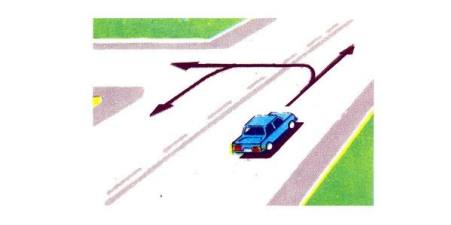
Which of the paths marked with arrows is allowed?
Answer options
Explanation
Straight ahead only.
In the middle of the carriageway a double solid line is drawn. The meaning of this marking is explicit: crossing it for any reason is prohibited. Any manoeuvre that requires you to cross this line — a left turn and a U-turn — is thereby prohibited, and the only route left for the blue car is straight ahead.
A double solid line is usually drawn where either each direction has more than one traffic lane or there is not enough visibility to cut across the opposing path. Its safety reason is exactly that: to turn left or make a U-turn you must cut across the entire width of the oncoming flow, and on a road where cars travel at a continuous speed that means entering the path of someone who is neither expecting you nor has time to brake.
The common exam trap is that, because the candidate sees no prohibitory sign in the picture, he assumes everything is free. But a marking, like a sign, is a legal command and can prohibit a manoeuvre on its own. The practical point is that to make a U-turn or go to the left you must drive on to the nearest permitted place — such as a junction where the marking is interrupted, or a place where the line becomes broken — and manoeuvre there, rather than jumping across the solid line en route.
• Both a left turn and travel in the opposite direction require crossing the double solid line, and that single marking closes both of them. • Straight-ahead movement is correct, but adding a left turn and a U-turn invalidates this option; a double solid line does not permit cutting across the opposing path.
Topic
The official Armenian theory exam has 20 questions. You may make at most 2 mistakes. Start mock exam
Related questions
- Is it allowed to put off a passenger on the road where a solid yellow line is drawn on the top surface of the curb and a "Stop is prohibited" sign is placed?
- What does this road sign mean?
- Which vehicles are allowed to park in the area of influence of the given road sign?
- With which road sign can a yellow dashed line marking be applied?
- Is it permitted to drive onto a guide island marked with wide white lines?
- Which vehicle is allowed to stop in the area covered by these signs?
- At what distance from the "Stop Line" or the "No Stopping" sign must a driver stop to miss an approaching train?
- If the traffic through a railway crossing is prohibited and there are no traffic lights, road signs, markings and a barrier, the driver must stop: