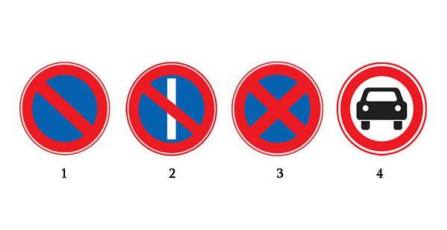
Which signs do not apply to public vehicles?
Answer options
Explanation
Only the fourth sign.
The first three signs concern stopping and parking: sign 1 no parking, sign 2 no parking on odd days of the month, and sign 3 no stopping. These prohibitions cover public service vehicles too; their only concession is that they may stop at designated and marked stops to pick up and set down passengers. Outside those stops, a bus is subject to the prohibition like any other vehicle.
Sign 4 belongs to a different family: a white circle with a red border and the image of a car, that is a prohibition on the movement of motor vehicles. Movement prohibitions do not cover public service vehicles. The logic is clear; the purpose of such a sign is to take general car traffic out of a street — a narrow street, a residential area, an old quarter — not to cut a bus route on which the people of that very district depend. The drivers of public service vehicles are also professionals travelling on a fixed and familiar route.
The distinction to keep in mind: a movement prohibition has nothing to do with public service vehicles, but a stopping and parking prohibition does; because the reason for a no-stopping sign is the danger of that particular spot — blocking the view, narrowing the carriageway, proximity to a junction — and a bus stopped there creates exactly the same danger as a car.
• "None" assumes public service vehicles have no exception at all, whereas the fourth sign is precisely their exception. • Sign 1 is no parking and, contrary to this option, is one of the very items that does bind public service vehicles.
Topic
The official Armenian theory exam has 20 questions. You may make at most 2 mistakes. Start mock exam
Related questions
- Is it allowed to enter the area marked with this sign when making a right turn?
- Which of the following signs prohibits traffic with a smaller space than the one shown on the sign?
- This road sign:
- This road sign shows:
- At what distance from the location of the dangerous part of the road are these signs placed in the settlements?
- Which of the following signs obliges to give way to vehicles entering or approaching a narrow section of the road in the opposite direction?
- Which of the following signs warns of approaching an intersection of equal roads?
- These signs allow traffic: