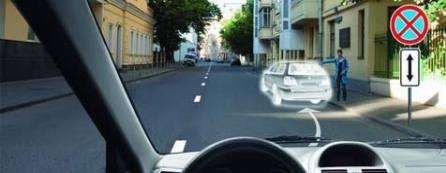
In this situation stopping to pick up a passenger is
Answer options
Explanation
It is prohibited in both cases; you have no right to stop either before the sign or after it.
The round blue sign with a red border and a cross is "no stopping", and it differs fundamentally from "no parking": no parking closes off only a prolonged stay and a brief halt to pick up or set down a passenger or goods remains permitted beneath it, whereas the cross sign prohibits any deliberate halting of a vehicle; even the few seconds needed in the picture to pick up that pedestrian at the kerb.
The plate beneath the sign is the key to the answer: an arrow with heads both upwards and downwards means "you are at this moment inside the sign's zone of effect" — the zone continues both behind and ahead of the point of installation. Memorise the three forms of this plate together: an upward arrow means the zone starts here, a downward arrow means it ends here, and a double-headed arrow means you are in the middle of the zone.
The safety reason is clear: on the narrow city street in the picture, with one traffic lane in each direction, a stopped vehicle blocks the whole lane and the drivers behind are forced to swerve suddenly into the opposing lane; at precisely the moment the passenger opens the door on the pavement side. The common exam trap is that the candidate wrongly extends the "picking up a passenger" exception, which belongs to no parking, to no stopping.
• It is tempting because many suppose a sign's zone always begins from the sign onwards; but the double-headed arrow says you are in the middle of the zone, so the prohibition holds after the sign too. • It is the reverse of the same error: it assumes the space before the sign is still free, whereas the downward head of the arrow shows the prohibition began further back.
Topic
The official Armenian theory exam has 20 questions. You may make at most 2 mistakes. Start mock exam
Related questions
- Is it allowed to stop in the passenger boarding lane marked with this sign?
- Is it allowed to put off a passenger on the road where a solid yellow line is drawn on the top surface of the curb and a "Stop is prohibited" sign is placed?
- Is it allowed to stop to put off a passenger in this case?
- In which picture did the driver correctly stop his car to drop off passengers?
- If the traffic through a railway crossing is prohibited and there are no traffic lights, road signs, markings and a barrier, the driver must stop:
- At what distance from the railway crossing is the parking of vehicles prohibited?
- If traffic through the railway crossing is prohibited and there are no traffic lights, road signs and markings, the driver must stop:
- Is the vehicle allowed to stop at the specified place to drop off the passenger?