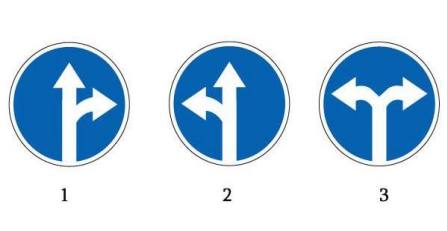
Which traffic sign forces the driver to go only to the left or to the right?
Answer options
Explanation
Sign 3 — the arrow forking to the left and right.
All three signs are round and blue, that is from the family of mandatory signs which prescribe the permitted directions of travel. To answer, it is enough to see whether each sign has an upward arrow — that is, permission to go straight ahead. Sign 1 permits straight ahead and right, sign 2 straight ahead and left, and only sign 3 has no straight arrow at all: it has two arrows, one going left and the other right. So only this sign compels the driver to turn one way or the other at the junction.
These signs take effect on the junction immediately beyond where they are posted, and once that junction is passed their requirement is spent. There is also a subtle point that earns marks in the exam: a mandatory sign that permits a left turn permits a U-turn as well. That is, beneath sign 3 you may make a U-turn, but you have no right to go straight ahead.
The safety reason for posting such a sign is usually the shape of the road itself: the road ahead may be one-way in the opposite direction, a dead end, or under works. Rather than the driver realising it at the mouth of the junction and being forced into hard braking or a sudden U-turn, the sign makes the decision before he reaches the junction and keeps the traffic flow smooth.
• Sign 1 permits straight ahead as well, so it compels no driver to turn; the only thing it closes is the left turn. • Sign 2 is the mirror image of sign 1 and again has a straight arrow; a candidate who sees only the left arrow and overlooks the upward one goes wrong right here.
Topic
The official Armenian theory exam has 20 questions. You may make at most 2 mistakes. Start mock exam
Related questions
- Is it allowed to enter the area marked with this sign when making a right turn?
- Which of the following signs prohibits traffic with a smaller space than the one shown on the sign?
- This road sign:
- This road sign shows:
- At what distance from the location of the dangerous part of the road are these signs placed in the settlements?
- Which of the following signs obliges to give way to vehicles entering or approaching a narrow section of the road in the opposite direction?
- Which of the following signs warns of approaching an intersection of equal roads?
- These signs allow traffic: