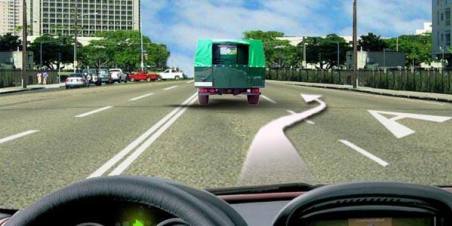
Is it allowed to continue driving in the direction indicated by the arrow?
Answer options
Explanation
Only for a brief stop to pick up or set down passengers.
The right-hand traffic lane in the picture is marked with the letter "Ա" on the carriageway; this lane is reserved for public-transport vehicles. The line separating it from your lane is broken, not solid — and that single detail determines the answer to the whole question.
When a dedicated lane's boundary is broken, entry by other cars is not absolutely prohibited but restricted: you may enter it to turn right, to enter and leave the road, and for a brief stop at the edge of the carriageway to pick up or set down passengers, provided you do not obstruct the movement of public-transport vehicles. If that same boundary were solid, entry would be prohibited in all circumstances.
The traffic and safety logic is clear: the whole purpose of a dedicated lane is that buses should pass the queue of traffic and keep to their timetable. If private cars were allowed to overtake in it or to travel long distances along it, the rationale of the dedicated lane would collapse and, worse, a private car and a bus travelling at different speeds in one lane would create a risk of rear-end impacts. But a stop of a few seconds at the right-hand edge does not disrupt the flow of buses.
The rule to memorise: look at the type of marking on the dedicated lane's boundary. Broken means "entry permitted for specific purposes", solid means "entry prohibited".
• "Prohibited" is the answer for a dedicated lane separated by a solid marking; in this picture the boundary is broken, so the prohibition is not absolute. • "Allowed in all cases" destroys the rationale of the dedicated lane; ordinary continuous travel by a private car in a bus lane is not permitted. • Overtaking a lorry by using the dedicated lane is exactly what the law is trying to prevent; entry for specific purposes is permitted only for turning, entering and leaving, and picking up and setting down passengers.
Topic
The official Armenian theory exam has 20 questions. You may make at most 2 mistakes. Start mock exam
Related questions
- Is it allowed to put off a passenger on the road where a solid yellow line is drawn on the top surface of the curb and a "Stop is prohibited" sign is placed?
- What does this road sign mean?
- Which vehicles are allowed to park in the area of influence of the given road sign?
- Which of the paths marked with arrows is allowed?
- With which road sign can a yellow dashed line marking be applied?
- Is it permitted to drive onto a guide island marked with wide white lines?
- Which vehicle is allowed to stop in the area covered by these signs?
- At what distance from the "Stop Line" or the "No Stopping" sign must a driver stop to miss an approaching train?