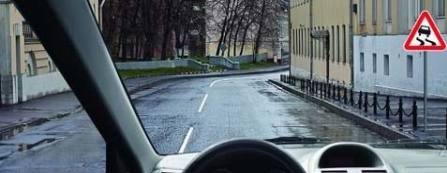
At what distance will the slippery road section start in the settlement?
Answer options
Explanation
At least 50 metres beyond the sign.
The triangular sign in the picture shows a vehicle with wheel skid marks: the "slippery road" warning. But the question is not about the hazard itself; it is about the placement distance of warning signs. The rule has two figures and it is those two you must memorise: within a built-up area a warning sign is posted 50 to 100 metres before the hazard, and outside a built-up area 150 to 300 metres. So in town, the earliest point at which the slippery section can begin is 50 metres beyond the sign.
The reason for the difference between these two ranges is speed. The distance must be enough for the driver to see the sign, understand its meaning and reduce speed smoothly without hard braking. At low urban speeds 50 metres suffices for this, but on an intercity road at high speed the same task requires several times the distance; that is why the sign is posted much earlier.
In the picture, look at the wet asphalt and the damp pavement: after this sign you should increase your distance from the vehicle ahead, avoid sudden braking and steering, and have reduced speed before reaching the slippery section, not on it. The common trap is choosing "immediately after the sign".
• 100 metres is the upper end of the placement range within a built-up area, not its minimum; the question asks for the minimum distance. • A warning sign is never posted right up against the hazard, because the driver would then have no opportunity to reduce speed.
Topic
The official Armenian theory exam has 20 questions. You may make at most 2 mistakes. Start mock exam
Related questions
- Is it allowed to stop in the passenger boarding lane marked with this sign?
- In which direction is a passenger car allowed to drive?
- In this situation stopping to pick up a passenger is
- Is a trailer passenger car allowed in a straight line at this intersection?
- This sign indicates the approach of such a tunnel
- Are vehicles performing regular transportation of passengers on all roads allowed to occupy the left most lane of a road that has 3 or more lanes in one direction?
- The driver of the white passenger car in this situation
- Are you obligated to give way to a passenger car if you continue driving straight ahead?