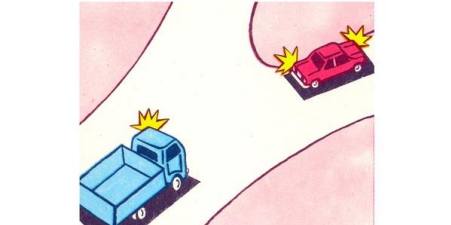
The driver of which vehicle must give way?
Answer options
Explanation
The blue car's driver.
The blue car and the red car are travelling on one road facing each other. The blue car's indicator is on and shows that this driver wants to turn left and enter the side road on the left. The rule is explicit: before turning left you must give priority to all vehicles coming from the opposite direction — whether they go straight or turn right. So it is the blue car's driver who must stop and let the red car through.
The safety reason for this rule lies in the geometry of the movement. A vehicle turning left cuts across the entire width of the opposing path in one moment, and at that same moment its own bodywork and the cars behind it block its view. If the driver's estimate of the oncoming car's speed is wrong by a few kilometres per hour, a head-on impact at a high relative speed follows; one of the deadliest kinds of junction crash.
Worth memorising: in a left turn, nothing — not a larger vehicle, not arriving at the junction earlier, not the side road being empty — takes the place of priority. And that is the common exam trap: because the candidate sees a goods vehicle as heavier and "more important", he puts it first; whereas weight and dimensions play no part in priority.
• The red car has its indicator on and looks as though it too is manoeuvring, which is what makes this option tempting; but it is coming from the opposite direction, and the one turning left must give way to it, not the reverse.
Topic
The official Armenian theory exam has 20 questions. You may make at most 2 mistakes. Start mock exam
Related questions
- Vehicles will cross the intersection in the following order:
- The last one to drive through the intersection:
- The first to drive through the intersection:
- The blue car will drive through the intersection:
- The second will drive through the intersection:
- The second to drive through the intersection:
- The last one to drive through the intersection:
- The second to drive through the intersection: