The second to drive through the intersection:
Answer options
Explanation
The blue car.
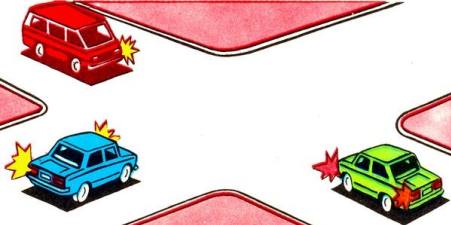
No priority signs and no traffic lights are visible in the picture, so the roads are of equal status and the governing rule is "priority to the right". Now look carefully at the indicators: all three vehicles have signalled left — the red van, the blue car and the green car all intend to turn left.
That point unties the knot. The red van and the green car are opposite each other and both are turning left; two vehicles turning left simultaneously from opposite directions do not cut across each other's paths and do not obstruct one another. So you need only see whom each has on its right. The green car's right is empty, so it goes first. The blue car has the green car on its right and moves after it; that is, it is the second to pass. The red van has the blue car on its right and is left last.
Worth memorising: at an equal-status junction, read the indicators first, then apply the right-hand rule. If two opposing vehicles both turn left, remove their interaction from the equation; the remaining chain almost always has one clear starting point: the vehicle whose right is empty.
• The green car is precisely the one whose right is empty, so it is the first to pass, not the second. • The red van has the blue car on its right and must move after it; it is the last to pass.
Topic
The official Armenian theory exam has 20 questions. You may make at most 2 mistakes. Start mock exam
Related questions
- Vehicles will cross the intersection in the following order:
- The last one to drive through the intersection:
- The first to drive through the intersection:
- The blue car will drive through the intersection:
- The second will drive through the intersection:
- The last one to drive through the intersection:
- The second to drive through the intersection:
- The second to drive through the intersection: