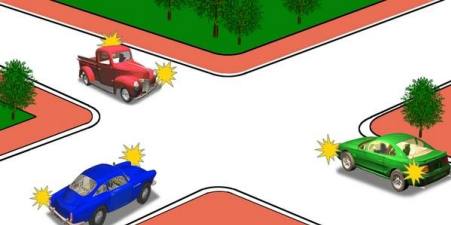
The second will drive through the intersection:
Answer options
Explanation
The blue car.
The junction has no signs and no traffic light, so all three roads are of equal status and only the right-hand rule operates: give way to a vehicle coming from your right.
Start with the car whose right is empty. The green car, entering from the right of the picture, has no vehicle on its right and is first. The blue car has green on its right and must give way to it; but blue itself is on the red pickup's right, so the pickup must stay behind it. The chain becomes green, blue, red, and the second vehicle is the blue car. All three drivers have signalled left. That detail makes the scene look complicated but does not change the order: two cars facing each other and both turning left do not cut across each other's paths, so the criterion remains the right hand.
Safety reason: most small urban junctions have no signs, and if each driver acts on his own judgement a front-to-side collision follows, which has virtually no crumple protection. The right-hand rule is a simple convention, the same for everyone, so that each driver can predict the other's behaviour. Trap: do not look for the largest vehicle or the car closest to the centre of the junction; just ask what is on each one's right.
• Green is first, not second; its right is empty and nobody precedes it. • Red is last; the blue car comes from its right and it must wait.
Topic
The official Armenian theory exam has 20 questions. You may make at most 2 mistakes. Start mock exam
Related questions
- Vehicles will cross the intersection in the following order:
- The last one to drive through the intersection:
- The first to drive through the intersection:
- The blue car will drive through the intersection:
- The second will drive through the intersection:
- The second to drive through the intersection:
- The last one to drive through the intersection:
- The second to drive through the intersection: