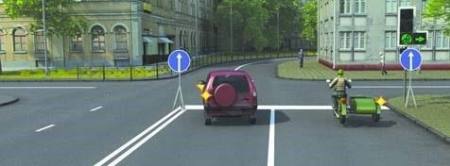
Which driver violates the rules of the road when making a turn?
Answer options
Explanation
Both drivers commit an offence.
On both sides of the road a round blue sign with an upward arrow is posted: "movement straight ahead only". This is a mandatory sign with a clear ruling; at the junction before which it is posted, no turn is permitted, neither left nor right.
Now look at the intentions of the two drivers. The red van has signalled left; a left turn both conflicts with the sign and means crossing the double solid line drawn down the middle of the carriageway — that is, two offences in one manoeuvre. The motorcycle with a sidecar on the right has switched on its right indicator, and a right turn is also closed by that same "straight ahead only" sign. So both drivers are breaking the law and the correct answer is "both".
The trap in this question is the traffic light on the right. The inexperienced driver reasons "the light is green and a green arrow is lit too, so I may turn". But a green light does not invalidate a mandatory sign; a traffic light takes precedence only over priority signs, not over mandatory and prohibitory ones. The safety reason is an engineering one: when a junction's route has been designed only for straight-ahead passage, any turn means cutting into a flow moving at speed and expecting no obstacle.
• This treats only the red van as an offender, but the sidecar motorcycle has signalled right too, and the "straight ahead only" sign closes the right turn as well. • This counts only the motorcycle as an offender, whereas the van's left turn, besides the sign, also cuts across the double solid line. • "Neither" means you have ignored the round blue sign; this sign is mandatory and prohibits both of the announced manoeuvres.
Topic
The official Armenian theory exam has 20 questions. You may make at most 2 mistakes. Start mock exam
Related questions
- Traffic is prohibited to:
- Which answer correctly identifies the vehicles that are allowed to drive?
- Traffic is allowed:
- If the arms of the traffic constable are outstretched to the sides or lowered, the movement of non-rail vehicles is allowed:
- In which picture does the driver turn correctly?
- If the arms of the traffic constable are outstretched to the sides or lowered, the movement of non-rail vehicles on the left and right sides is allowed:
- Traffic is prohibited:
- Which vehicles have the right to continue driving in this situation?