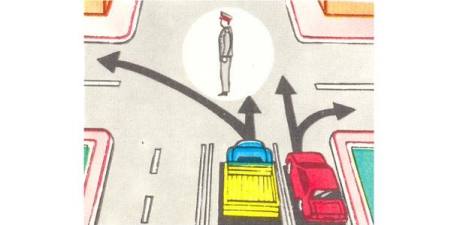
Traffic is prohibited:
Answer options
Explanation
The blue-and-yellow car's left turn is prohibited.
The controller is standing in profile with his arms lowered, so both cars arriving from the bottom of the picture enter the junction from his side. From the controller's side a non-rail vehicle has only the right to go straight and turn right; a left turn and a U-turn are closed.
Now read the arrows in the picture by that criterion. Two paths are drawn for the blue-and-yellow car: one straight and one turning left. The straight path is permitted and the left path is not, so the only thing prohibited in this scene is that car's left turn. Two arrows are drawn for the red car as well, straight and right, and both are on the permitted list, so this car has no restriction on either of its paths.
The main lesson is that a controller's signal must not be read as "this car is permitted or prohibited", but must be examined direction by direction for each car. One vehicle can be permitted for one path and prohibited for another. The safety reason is clear too: a left turn at a junction cuts across the oncoming flow and the crossing flows and is the most dangerous junction manoeuvre; that is why, in all the controller's signals, it is the first movement to be closed.
• Straight-ahead movement is permitted for both cars and the red car's right turn is permitted too; this option has declared three permitted paths prohibited. • The red car goes only straight and to the right, and both are compatible with the controller's signal, so there is no reason to treat it as prohibited.
Topic
The official Armenian theory exam has 20 questions. You may make at most 2 mistakes. Start mock exam
Related questions
- Traffic is prohibited to:
- Which answer correctly identifies the vehicles that are allowed to drive?
- Traffic is allowed:
- If the arms of the traffic constable are outstretched to the sides or lowered, the movement of non-rail vehicles is allowed:
- In which picture does the driver turn correctly?
- If the arms of the traffic constable are outstretched to the sides or lowered, the movement of non-rail vehicles on the left and right sides is allowed:
- Which vehicles have the right to continue driving in this situation?
- Who has he right to continue on the designated paths?