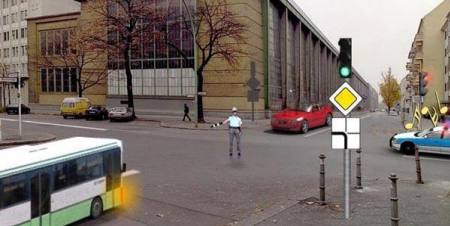
Which vehicles have the right to continue driving in this situation?
Answer options
Explanation
The patrol car in all directions and the bus only to the right.
The traffic controller has extended his right arm forward. Memorise the three clauses of this signal precisely: from the controller's left side a non-rail vehicle may move in all directions; from his chest side only a right turn is permitted; and from his right side and from behind his back no movement at all is permitted.
Divide the scene by those three clauses. The patrol car arrives from the controller's left side, so it may go in any direction it wishes. The bus faces the controller's chest, so its only choice is a right turn, and if it goes straight or turns left it commits an offence. The red passenger car is on the side this signal has closed completely and must stop.
But the most important lesson of this picture is something else: in that same frame a green traffic light is lit and a yellow "priority road" sign is posted, and neither of them decides. A traffic controller's gesture takes precedence over the light, the signs and the markings. The reason is functional: a controller enters a junction when the situation is abnormal — a light failure, an accident, congestion or a convoy passing — and if drivers could invoke the light, the whole purpose of his presence would be destroyed. So look at the controller's body first, then at the light.
• This also treats the passenger car as permitted, whereas it enters from the side that is completely closed with the right arm extended forward; the light being green changes nothing. • The patrol car really is permitted, but this option leaves out the bus; the bus comes from the controller's chest side and has the right to turn right.
Topic
The official Armenian theory exam has 20 questions. You may make at most 2 mistakes. Start mock exam
Related questions
- Traffic is prohibited to:
- Which answer correctly identifies the vehicles that are allowed to drive?
- Traffic is allowed:
- If the arms of the traffic constable are outstretched to the sides or lowered, the movement of non-rail vehicles is allowed:
- In which picture does the driver turn correctly?
- If the arms of the traffic constable are outstretched to the sides or lowered, the movement of non-rail vehicles on the left and right sides is allowed:
- Traffic is prohibited:
- Who has he right to continue on the designated paths?