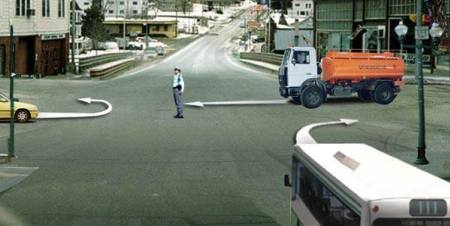
Who has he right to continue on the designated paths?
Answer options
Explanation
Only the bus driver.
The traffic controller's arms are lowered and he is standing in profile to the bus. The meaning of this signal is fixed: from the controller's left and right sides, going straight and turning right are free, and from his chest and back sides no movement at all is permitted.
Three paths are drawn on the picture with white arrows, and each must be judged separately. The bus comes from the controller's side and its arrow shows a right turn; that is exactly within the permitted range, so the bus may go. The tanker lorry has taken the straight path but comes from the side this signal has closed, so it must stop. The yellow passenger car is in the worst position: its arrow is a full arc back into the opposite direction, that is, a U-turn. A U-turn is not permitted under a controller's signal from any side and in any case.
Keep this as a simple rule: under a controller's direction, a left turn and a U-turn are never on the table; the only thing you need to check is whether your position relative to his body leaves straight-ahead movement and a right turn open. The safety reason is clear too: a U-turn at a junction under a controller's direction means blocking both axes at once, at a moment when nobody expects it.
• The lorry comes from the side the controller's signal has closed; the straight arrow in the picture shows only the driver's intention, not his permission to move. • The bus is right but adding the lorry is wrong; the lorry's position relative to the controller's body gives it no permission to pass. • The yellow passenger car intends to make a U-turn, and a U-turn under a controller's direction is not permitted from any side, so this combination is wrong from the outset.
Topic
The official Armenian theory exam has 20 questions. You may make at most 2 mistakes. Start mock exam
Related questions
- Traffic is prohibited to:
- Which answer correctly identifies the vehicles that are allowed to drive?
- Traffic is allowed:
- If the arms of the traffic constable are outstretched to the sides or lowered, the movement of non-rail vehicles is allowed:
- In which picture does the driver turn correctly?
- If the arms of the traffic constable are outstretched to the sides or lowered, the movement of non-rail vehicles on the left and right sides is allowed:
- Traffic is prohibited:
- Which vehicles have the right to continue driving in this situation?