Driving is allowed
Answer options
Explanation
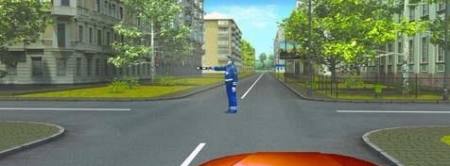
Movement in all directions is permitted.
The traffic controller has extended his right arm forward and you reach the junction from his left side. This is the only position that receives the widest permission: from the controller's left side a non-rail vehicle may move in all directions — straight, right, left, and even make a U-turn. A rail vehicle from that same side has only the right to turn left.
Comparing the three clauses of this signal is the best way to memorise it: the left side means all directions, the chest means only a right turn, the right side and the back mean nothing. That is, by extending his right arm the controller has effectively opened the flow on his own left completely and restricted the rest in order to protect it.
But do not confuse "permitted" with "safe". Permission to move does not exempt you from the general duties: when turning you must give way to pedestrians crossing the carriageway you are entering, before crossing the rails you must be sure the tram's path is clear, and you must perform your manoeuvre so as not to get stuck in the middle of the junction. And the last point is a constant: a traffic controller's gesture takes precedence over the traffic light, the signs and the markings, so look at his body first when deciding.
• "Straight and right" belongs to the case where the controller's arms are lowered or extended to the sides; with the right arm extended forward, his left side has no restriction of direction. • "Only right" is the clause for the controller's chest side, not his left side; this option has misread your position relative to the controller's body.
Topic
The official Armenian theory exam has 20 questions. You may make at most 2 mistakes. Start mock exam
Related questions
- Traffic is prohibited to:
- Which answer correctly identifies the vehicles that are allowed to drive?
- Traffic is allowed:
- If the arms of the traffic constable are outstretched to the sides or lowered, the movement of non-rail vehicles is allowed:
- In which picture does the driver turn correctly?
- If the arms of the traffic constable are outstretched to the sides or lowered, the movement of non-rail vehicles on the left and right sides is allowed:
- Traffic is prohibited:
- Which vehicles have the right to continue driving in this situation?